
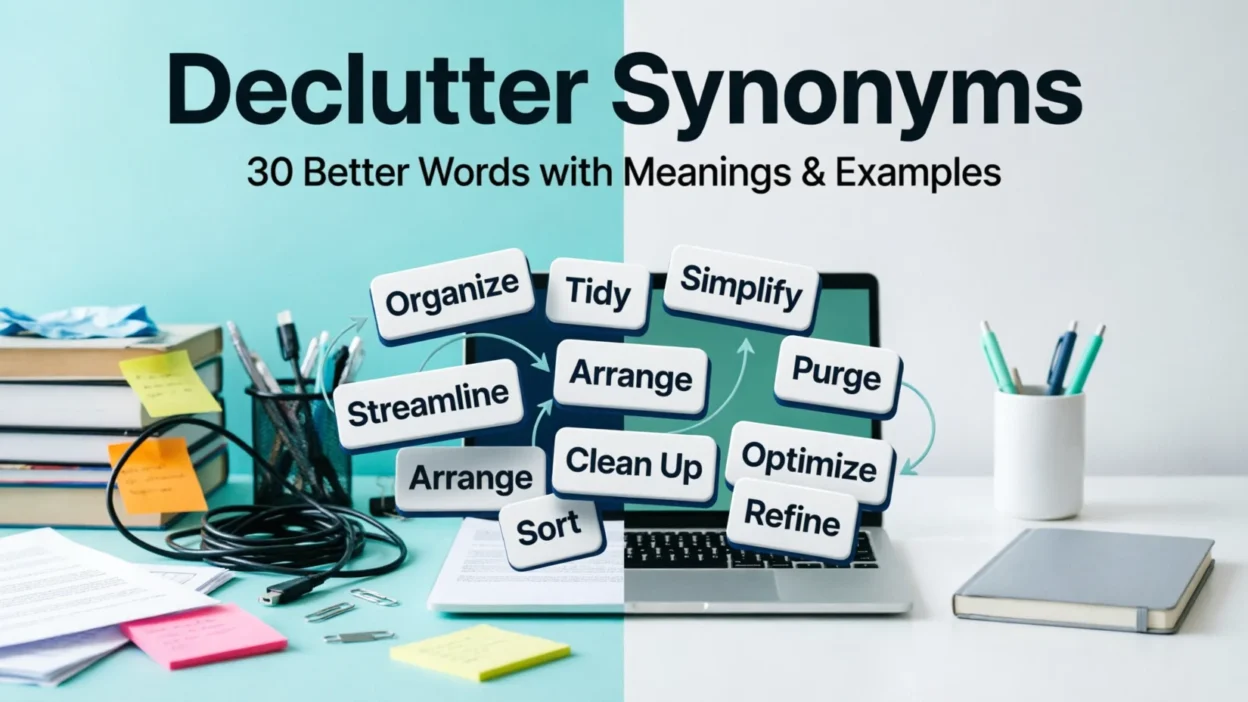
If you’re searching for the best declutter synonyms, you’re probably looking for different ways to express the idea of cleaning up, organizing, or removing unnecessary items. if you’re writing an essay, improving your vocabulary, creating content, or simply learning English, knowing several alternatives to declutter helps you communicate more naturally.
The word declutter has become increasingly popular in conversations about home organization, productivity, digital organization, and minimalism. However, depending on your sentence, another word may fit better than “declutter.” Some synonyms sound formal, while others are better for casual conversations or professional writing.
In this guide, you’ll discover 30 declutter synonyms, their meanings, example sentences, and the best situations to use them. You’ll also learn how to choose the right synonym based on tone and context.
What Does “Declutter” Mean?
Simple Meaning
Declutter means to remove unnecessary, unwanted, or unused items from a space, document, or digital area to make it cleaner, simpler, and more organized.
It can refer to:
- Cleaning a messy room
- Organizing a workspace
- Deleting unnecessary computer files
- Simplifying writing or design
- Removing distractions from daily life
Tone and Usage Context
The word declutter is commonly used in:
- Home organization
- Interior design
- Productivity advice
- Minimalist lifestyle
- Digital organization
- Writing and editing
30 Best Declutter Synonyms
1. Organize
Meaning
Arrange things neatly and logically.
Example:
She organized her desk before starting work.
Best Usage Context:
Perfect for homes, offices, schedules, and files.
2. Tidy
Meaning
Make something neat and clean.
Example:
Please tidy your bedroom before dinner.
Best Usage Context:
Casual everyday conversations.
3. Clean Up
Meaning
Remove dirt, mess, or unnecessary items.
Example:
We cleaned up the garage last weekend.
Best Usage Context:
General cleaning and organizing.
4. Simplify
Meaning
Make something easier or less complicated.
Example:
The new design simplifies the user experience.
Best Usage Context:
Writing, design, and workflows.
5. Streamline
Meaning
Improve efficiency by removing unnecessary steps.
Example:
The company streamlined its hiring process.
Best Usage Context:
Business and productivity.
6. Purge
Meaning
Remove unwanted items completely.
Example:
She purged old clothes from her closet.
Best Usage Context:
Minimalism and deep cleaning.
7. Clear Out
Meaning
Remove everything unnecessary from a place.
Example:
We cleared out the attic.
Best Usage Context:
Storage spaces and homes.
8. Sort
Meaning
Arrange items into categories.
Example:
Sort the papers by date.
Best Usage Context:
Documents and collections.
9. Arrange
Meaning
Put things in a proper order.
Example:
He arranged the books alphabetically.
Best Usage Context:
Organization and decoration.
10. Neaten
Meaning
Make something look tidy.
Example:
Neaten your workspace before the meeting.
Best Usage Context:
Office and home environments.
11. Order
Meaning
Place things systematically.
Example:
Order the files by project name.
Best Usage Context:
Formal organization.
12. Reorganize
Meaning
Organize again in a better way.
Example:
We reorganized the kitchen cabinets.
Best Usage Context:
Improving existing systems.
13. Trim
Meaning
Reduce unnecessary parts.
Example:
Trim the report to five pages.
Best Usage Context:
Writing and editing.
14. Reduce
Meaning
Make something smaller or less.
Example:
Reduce unnecessary expenses.
Best Usage Context:
General improvement.
15. Eliminate
Meaning
Remove completely.
Example:
Eliminate duplicate files.
Best Usage Context:
Professional writing.
16. Remove
Meaning
Take something away.
Example:
Remove old furniture.
Best Usage Context:
Universal usage.
17. Minimize
Meaning
Make as small as possible.
Example:
Minimize distractions while studying.
Best Usage Context:
Productivity.
18. Edit
Meaning
Remove unnecessary content.
Example:
Edit the article before publishing.
Best Usage Context:
Writing and media.
19. Refine
Meaning
Improve by making small changes.
Example:
Refine your presentation.
Best Usage Context:
Professional work.
20. Optimize
Meaning
Make as effective as possible.
Example:
Optimize your workspace.
Best Usage Context:
Technology and productivity.
21. Consolidate
Meaning
Combine into fewer parts.
Example:
Consolidate your notes.
Best Usage Context:
Business and education.
22. Filter
Meaning
Remove unwanted items.
Example:
Filter unnecessary emails.
Best Usage Context:
Digital organization.
23. Weed Out
Meaning
Remove unwanted items gradually.
Example:
We weeded out old documents.
Best Usage Context:
Collections and records.
24. Cull
Meaning
Select by removing less useful items.
Example:
Cull duplicate photos.
Best Usage Context:
Photography and archives.
25. Prune
Meaning
Cut away unnecessary parts.
Example:
Prune outdated content.
Best Usage Context:
Writing, websites, and gardening.
26. Cleanse
Meaning
Remove unwanted or harmful elements.
Example:
Cleanse your inbox.
Best Usage Context:
Digital and wellness topics.
27. Detox
Meaning
Remove unnecessary digital or mental clutter.
Example:
Take a digital detox this weekend.
Best Usage Context:
Technology and lifestyle.
28. Refresh
Meaning
Make something feel new again.
Example:
Refresh your office layout.
Best Usage Context:
Interior design and branding.
29. Revamp
Meaning
Improve through major changes.
Example:
Revamp your workspace.
Best Usage Context:
Business and design.
30. Overhaul
Meaning
Completely improve or reorganize.
Example:
The company overhauled its filing system.
Best Usage Context:
Large-scale improvements.
Comparison Guide: When to Use Different Declutter Synonyms
Everyday Cleaning
| Synonym | Best For |
|---|---|
| Tidy | Daily cleaning |
| Clean Up | General mess |
| Organize | Home and office |
| Neaten | Quick improvements |
| Arrange | Putting things in order |
Productivity and Business
| Synonym | Best For |
|---|---|
| Streamline | Processes |
| Optimize | Efficiency |
| Consolidate | Combining information |
| Refine | Improving quality |
| Simplify | Easier workflows |
Removing Unwanted Items
| Synonym | Best For |
|---|---|
| Purge | Deep cleaning |
| Eliminate | Formal writing |
| Weed Out | Gradual removal |
| Cull | Selecting the best |
| Remove | General situations |
Writing and Editing
| Synonym | Best For |
|---|---|
| Edit | Documents |
| Trim | Shortening text |
| Simplify | Clear writing |
| Prune | Removing unnecessary content |
| Refine | Final improvements |
How to Choose the Right Declutter Synonym
Use Organize when…
You want to focus on arranging items neatly instead of throwing things away.
Use Purge when…
You’re removing a large number of unwanted belongings.
Use Simplify when…
Talking about reducing complexity in writing, design, or life.
Use Streamline when…
Improving efficiency in business, projects, or workflows.
Use Clean Up when…
Referring to general cleaning or removing clutter in everyday speech.
Use Optimize when…
Making a system, workspace, or process perform better.
Use Edit when…
Working on documents, articles, books, or videos.
Use Cull or Weed Out when…
Selecting the best items while removing unnecessary ones.
Quick Tips for Using Declutter Synonyms
Choose based on your purpose.
If you’re talking about physical spaces, words like tidy, organize, and clean up work well. For digital spaces, consider filter, optimize, or streamline. When discussing writing, edit, trim, and refine are better choices.
Match the tone.
Casual conversations often use tidy or clean up, while professional writing benefits from streamline, optimize, or consolidate.
Avoid repetition.
Using different synonyms throughout your writing makes your content more engaging and demonstrates a richer vocabulary.
FAQs:
Is “organize” the same as “declutter”?
Not exactly. Organize means arranging items neatly, while declutter usually involves removing unnecessary items before organizing.
What is the strongest synonym for declutter?
Purge is one of the strongest synonyms because it suggests removing a large amount of unwanted items.
Which synonym is best for digital files?
Organize, filter, optimize, and streamline are excellent choices for digital spaces.
Is “tidy” more casual than “declutter”?
Yes. Tidy is an everyday word, while declutter often emphasizes reducing excess belongings or distractions.
Can declutter be used for writing?
Yes. Writers often use declutter to describe removing unnecessary words, repetitive ideas, or confusing sentences.
Conclusion
Learning declutter synonyms helps you express ideas more clearly in everyday conversations, professional writing, and creative projects. While organize, tidy, and clean up are excellent everyday alternatives, words like streamline, optimize, purge, and refine offer more precise meanings depending on the situation.
The best synonym depends on your context. Whether you’re cleaning a room, improving a document, organizing digital files, or simplifying your workflow, choosing the right word makes your communication more natural, engain’

Patrick Frank is a talented humor writer at PunHubs.com, specializing in witty puns and playful wordplay. Passionate about language and comedy, he creates content that entertains and delights readers. Patrick’s goal is to spread laughter through clever jokes, funny one-liners, and engaging pun collections for all audiences.