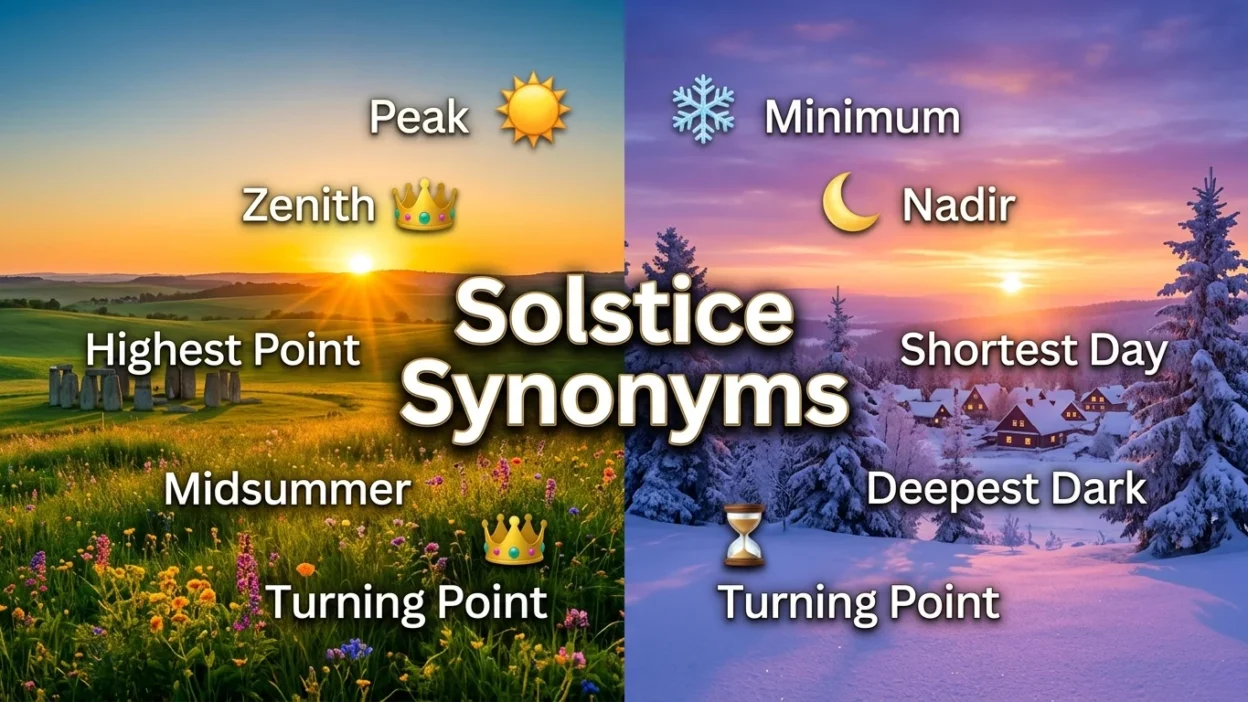
If you are searching for solstice synonyms, you may be looking for alternative words or related terms that describe the longest and shortest days of the year. Understanding these words can help students, writers, ESL learners, and content creators expand their vocabulary and communicate more precisely.
The word solstice refers to either of the two times each year when the sun reaches its highest or lowest point in the sky relative to Earth. These events mark the beginning of summer and winter in many parts of the world and have cultural, scientific, and historical significance.
While there is no perfect one-word replacement for solstice in every context, many related terms, seasonal expressions, and astronomical words can be used depending on your purpose. This guide explores the meaning of solstice and provides useful alternatives with examples and usage tips.
What Does Solstice Mean?
A solstice is an astronomical event that occurs twice a year:
- Summer Solstice – the longest day of the year.
- Winter Solstice – the shortest day of the year.
The term comes from Latin words meaning “sun” and “standing still,” referring to the sun’s apparent pause before changing direction in the sky.
Example:
“The summer solstice marks the official beginning of summer in many countries.”
30 Solstice Synonyms and Related Terms
1. Midwinter
Meaning: The middle of the winter season.
Example: “Many ancient festivals were celebrated during midwinter.”
Best Usage Context: Winter solstice discussions.
2. Midsummer
Meaning: The middle period of summer.
Example: “The town hosts a large celebration at midsummer.”
Best Usage Context: Summer solstice events.
3. Seasonal Turning Point
Meaning: A major change between seasons.
Example: “The solstice acts as a seasonal turning point.”
Best Usage Context: Educational writing.
4. Astronomical Event
Meaning: A significant occurrence in space.
Example: “The solstice is an important astronomical event.”
Best Usage Context: Scientific content.
5. Solar Milestone
Meaning: A key point in the sun’s annual cycle.
Example: “The summer solstice is a major solar milestone.”
Best Usage Context: Astronomy articles.
6. Sun Turning Point
Meaning: The point where the sun’s apparent path changes direction.
Example: “Ancient cultures tracked each sun turning point.”
Best Usage Context: Historical discussions.
7. Seasonal Marker
Meaning: A sign that indicates a seasonal change.
Example: “The winter solstice serves as a seasonal marker.”
Best Usage Context: General writing.
8. Solar Transition
Meaning: A shift in the sun’s position.
Example: “The solar transition was observed by astronomers.”
Best Usage Context: Scientific explanations.
9. Sun Festival
Meaning: A celebration connected to the sun.
Example: “Villagers attended a traditional sun festival.”
Best Usage Context: Cultural content.
10. Solar Celebration
Meaning: A festival honoring solar events.
Example: “The community held a solar celebration.”
Best Usage Context: Event descriptions.
11. Daylight Peak
Meaning: The maximum amount of daylight.
Example: “The summer solstice represents the daylight peak.”
Best Usage Context: Summer solstice references.
12. Longest Day
Meaning: The day with the most daylight hours.
Example: “Many people enjoy the longest day outdoors.”
Best Usage Context: Casual writing.
13. Shortest Day
Meaning: The day with the fewest daylight hours.
Example: “The shortest day arrives in December.”
Best Usage Context: Winter discussions.
14. Solar Apex
Meaning: The highest point in a solar cycle.
Example: “The sun reaches its solar apex during the solstice.”
Best Usage Context: Formal astronomy.
15. Seasonal Threshold
Meaning: The boundary between seasons.
Example: “The solstice marks a seasonal threshold.”
Best Usage Context: Descriptive writing.
16. Celestial Event
Meaning: An event involving heavenly bodies.
Example: “The solstice is a well-known celestial event.”
Best Usage Context: Educational articles.
17. Sun Alignment
Meaning: A particular position of the sun.
Example: “Ancient monuments tracked sun alignment.”
Best Usage Context: Archaeological discussions.
18. Solar Occasion
Meaning: A notable solar occurrence.
Example: “The community gathered for the solar occasion.”
Best Usage Context: Formal writing.
19. Astronomical Turning Point
Meaning: A significant change in celestial movement.
Example: “The solstice is an astronomical turning point.”
Best Usage Context: Scientific contexts.
20. Seasonal Shift
Meaning: A movement from one season toward another.
Example: “The solstice signals a seasonal shift.”
Best Usage Context: General use.
21. Solar Landmark
Meaning: A notable point in the solar calendar.
Example: “The solstice is a solar landmark.”
Best Usage Context: Educational content.
22. Nature’s Turning Point
Meaning: A major seasonal change in nature.
Example: “Farmers observed nature’s turning point.”
Best Usage Context: Nature writing.
23. Sun Cycle Event
Meaning: An event within the yearly solar cycle.
Example: “The solstice is part of the sun cycle event calendar.”
Best Usage Context: Astronomy.
24. Seasonal Observatory Point
Meaning: A moment used for observing seasonal changes.
Example: “Researchers studied this seasonal observatory point.”
Best Usage Context: Academic writing.
25. Solar High Point
Meaning: The highest solar position.
Example: “June brings the solar high point of the year.”
Best Usage Context: Summer solstice.
26. Seasonal Milestone
Meaning: An important point in the yearly cycle.
Example: “The winter solstice is a seasonal milestone.”
Best Usage Context: General writing.
27. Solar Turning Day
Meaning: The day the sun appears to reverse direction.
Example: “Ancient calendars tracked the solar turning day.”
Best Usage Context: Historical discussions.
28. Seasonal Event
Meaning: An event linked to seasonal changes.
Example: “The solstice is a major seasonal event.”
Best Usage Context: Broad usage.
29. Celestial Milestone
Meaning: A notable event in the heavens.
Example: “The solstice is a celestial milestone observed worldwide.”
Best Usage Context: Formal descriptions.
30. Solar Calendar Marker
Meaning: A reference point in the solar year.
Example: “The solstice acts as a solar calendar marker.”
Best Usage Context: Educational and scientific content.
Solstice Synonyms Comparison Table
| Term | Best For | Tone |
|---|---|---|
| Midsummer | Summer celebrations | Casual |
| Midwinter | Winter discussions | Casual |
| Longest Day | Everyday writing | Simple |
| Shortest Day | Everyday writing | Simple |
| Celestial Event | Educational content | Formal |
| Astronomical Event | Scientific writing | Technical |
| Seasonal Shift | General descriptions | Neutral |
| Solar Milestone | Astronomy articles | Formal |
| Seasonal Marker | Educational use | Neutral |
| Nature’s Turning Point | Creative writing | Descriptive |
How to Choose the Right Solstice Synonym
For Scientific Writing
Use:
- Astronomical Event
- Celestial Event
- Solar Apex
- Astronomical Turning Point
These terms work best in educational and research-focused content.
For Creative Writing
Use:
- Nature’s Turning Point
- Seasonal Threshold
- Solar Milestone
- Sun Turning Point
These add imagery and style to your writing.
For Casual Conversations
Use:
- Longest Day
- Shortest Day
- Midsummer
- Midwinter
These are easy for most readers to understand.
For Cultural or Historical Topics
Use:
- Sun Festival
- Solar Celebration
- Solar Turning Day
- Seasonal Milestone
These fit discussions about traditions and ancient practices.
Common Mistakes When Using Solstice Synonyms
- Do not use every synonym as a direct replacement for solstice.
- Some terms describe related ideas rather than the exact astronomical event.
- Consider your audience before choosing technical vocabulary.
- Use simple alternatives when writing for ESL learners or younger readers.
Conclusion
Understanding solstice synonyms can help you write more clearly and creatively. While solstice is a specific astronomical term, related expressions such as midsummer, midwinter, seasonal shift, celestial event, and solar milestone can provide variety and improve your writing.
The best synonym depends on your context. Scientific writing benefits from precise terms like astronomical event, while creative and casual writing often sounds more natural with expressions like longest day, shortest day, or nature’s turning point.
By choosing the right alternative, you can make your content more engaging, accurate, and reader-friendly.