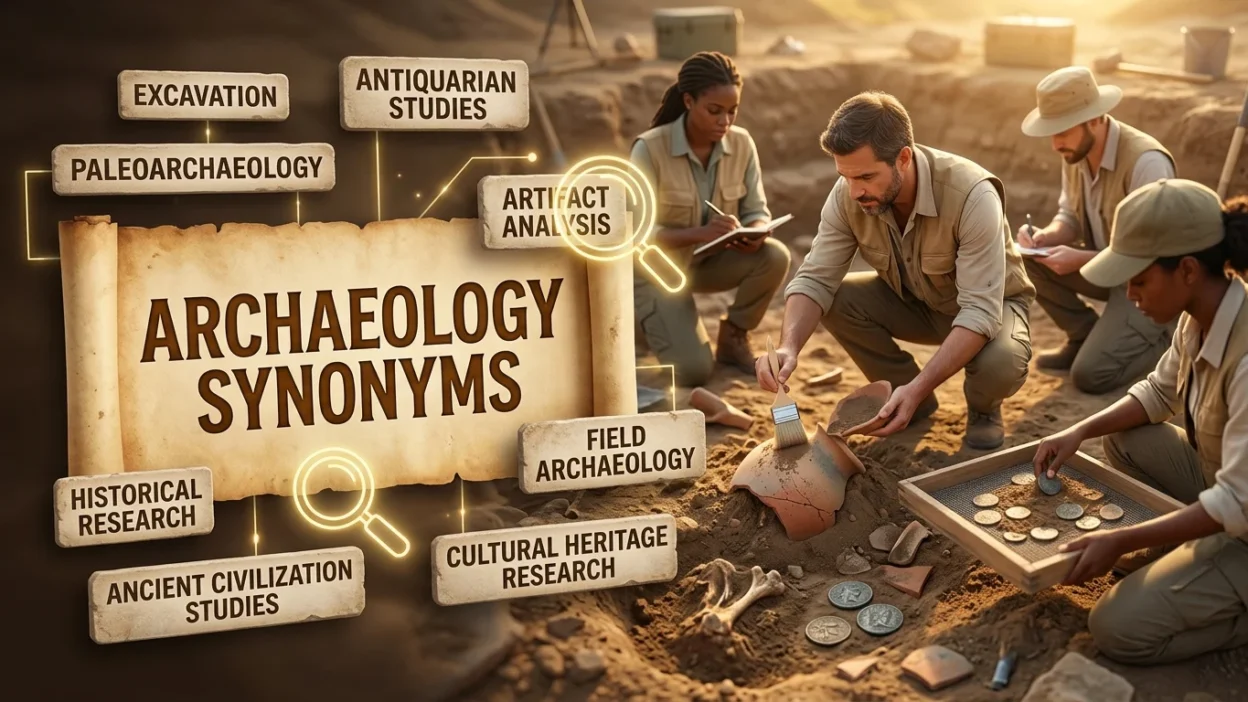
Archaeology is an important word often used in history, science, education, and writing. However, repeating the same term again and again can make your writing feel repetitive.
Learning archaeology synonyms helps students, ESL learners, writers, and content creators communicate ideas more clearly and naturally.
If you are writing a school essay, creating educational content, or improving your English vocabulary, understanding alternative words related to archaeology can make your writing more engaging. Different synonyms may fit different situations, tones, and contexts.
In this guide, you will learn the meaning of archaeology, discover 30 useful archaeology synonyms, see practical examples, and understand when to use each alternative.
What Does Archaeology Mean?
Archaeology is the study of past human societies through physical remains such as artifacts, tools, buildings, pottery, bones, and monuments. Archaeologists investigate these materials to understand how people lived in earlier times.
In simple English, archaeology is the science of learning about history by examining objects and evidence left behind by ancient people.
30 Archaeology Synonyms
1. Excavation
Meaning: The process of digging and uncovering historical remains.
Example: The excavation revealed an ancient temple.
Best Usage Context: Fieldwork and digging activities.
2. Antiquarian Study
Meaning: Research focused on ancient objects and history.
Example: His antiquarian study examined Roman coins.
Best Usage Context: Historical research.
3. Historical Investigation
Meaning: Exploring evidence from the past.
Example: The project involved historical investigation of the region.
Best Usage Context: Academic writing.
4. Ancient History Research
Meaning: Study of ancient civilizations and cultures.
Example: She specializes in ancient history research.
Best Usage Context: Educational content.
5. Heritage Research
Meaning: Study of cultural and historical heritage.
Example: Heritage research uncovered forgotten traditions.
Best Usage Context: Cultural preservation.
6. Artifact Study
Meaning: Examination of historical objects.
Example: Artifact study helped identify the settlement’s age.
Best Usage Context: Museum and research work.
7. Paleohistory
Meaning: Study of prehistoric human history.
Example: Paleohistory provides insights into early communities.
Best Usage Context: Prehistoric topics.
8. Historical Science
Meaning: Scientific study of past events.
Example: Archaeology is often considered a historical science.
Best Usage Context: Academic discussions.
9. Cultural Research
Meaning: Investigation of human cultures and traditions.
Example: Cultural research revealed ancient customs.
Best Usage Context: Social and historical studies.
10. Anthropological Research
Meaning: Study of humans and their societies.
Example: Anthropological research complemented the excavation findings.
Best Usage Context: Human history studies.
11. Relic Investigation
Meaning: Examination of historical relics.
Example: Relic investigation confirmed the artifact’s origin.
Best Usage Context: Artifact analysis.
12. Historical Exploration
Meaning: Discovering and studying historical evidence.
Example: Historical exploration led to important discoveries.
Best Usage Context: General historical writing.
13. Civilization Study
Meaning: Research on ancient civilizations.
Example: Civilization study helps explain social development.
Best Usage Context: Ancient societies.
14. Prehistoric Research
Meaning: Study of life before recorded history.
Example: Prehistoric research uncovered stone tools.
Best Usage Context: Early human history.
15. Ancient Culture Study
Meaning: Examination of past cultures.
Example: Ancient culture study revealed unique traditions.
Best Usage Context: Cultural analysis.
16. Field Archaeology
Meaning: On-site archaeological work.
Example: Field archaeology requires careful excavation.
Best Usage Context: Professional archaeology.
17. Site Investigation
Meaning: Examination of a historical location.
Example: Site investigation identified ancient structures.
Best Usage Context: Excavation projects.
18. Historical Survey
Meaning: Systematic examination of historical sites.
Example: A historical survey mapped several ruins.
Best Usage Context: Research planning.
19. Material Culture Study
Meaning: Analysis of physical cultural objects.
Example: Material culture study explains daily life in ancient times.
Best Usage Context: Academic research.
20. Ruin Exploration
Meaning: Investigation of ancient ruins.
Example: Ruin exploration attracted researchers worldwide.
Best Usage Context: Travel and history content.
21. Artifact Research
Meaning: Detailed study of historical artifacts.
Example: Artifact research revealed trade connections.
Best Usage Context: Museum studies.
22. Historical Discovery
Meaning: Finding evidence from the past.
Example: The excavation led to a major historical discovery.
Best Usage Context: News and educational writing.
23. Cultural Heritage Study
Meaning: Research into cultural heritage.
Example: Cultural heritage study preserves valuable traditions.
Best Usage Context: Preservation projects.
24. Ancient Relic Research
Meaning: Study of relics from ancient times.
Example: Ancient relic research uncovered rare artifacts.
Best Usage Context: Historical investigations.
25. Past Civilization Analysis
Meaning: Examination of former societies.
Example: Past civilization analysis revealed economic systems.
Best Usage Context: Academic papers.
26. Historical Artifact Examination
Meaning: Careful analysis of ancient objects.
Example: Historical artifact examination confirmed authenticity.
Best Usage Context: Museums and laboratories.
27. Archaeological Investigation
Meaning: Formal archaeological research.
Example: Archaeological investigation continued for several months.
Best Usage Context: Professional reports.
28. Heritage Exploration
Meaning: Discovery of cultural heritage sites.
Example: Heritage exploration attracts many researchers.
Best Usage Context: Tourism and education.
29. Ancient World Research
Meaning: Study of ancient societies and cultures.
Example: Ancient world research helps explain human development.
Best Usage Context: History content.
30. Historical Excavation
Meaning: Digging conducted to uncover historical remains.
Example: Historical excavation exposed ancient foundations.
Best Usage Context: Archaeological projects.
Archaeology Synonyms Comparison Table
| Synonym | Best For | Formality |
| Excavation | Digging sites | Medium |
| Artifact Study | Object analysis | High |
| Historical Investigation | Academic writing | High |
| Cultural Research | Human traditions | Medium |
| Heritage Research | Preservation projects | High |
| Prehistoric Research | Early human history | High |
| Site Investigation | Historical locations | Medium |
| Historical Exploration | General use | Medium |
| Civilization Study | Ancient societies | High |
| Ruin Exploration | Travel and history content | Medium |
How to Choose the Right Synonym
For Academic Writing
Use:
- Historical Investigation
- Archaeological Investigation
- Material Culture Study
- Civilization Study
For Educational Content
Use:
- Ancient History Research
- Cultural Research
- Heritage Research
- Ancient World Research
For Excavation Projects
Use:
- Excavation
- Site Investigation
- Historical Excavation
- Field Archaeology
For Museums and Artifacts
Use:
- Artifact Study
- Artifact Research
- Historical Artifact Examination
- Relic Investigation
For General Readers
Use:
- Historical Exploration
- Historical Discovery
- Heritage Exploration
- Ruin Exploration
Common Mistakes When Using Archaeology Synonyms
- Using “excavation” as a complete replacement for archaeology in every situation.
- Confusing archaeology with anthropology.
- Using highly technical terms in beginner-level content.
- Ignoring the context of historical or cultural research.
Conclusion
Learning archaeology synonyms can improve your vocabulary, strengthen your writing, and help you communicate historical ideas more effectively.
While archaeology remains the primary term, alternatives such as excavation, historical investigation, artifact study, heritage research, and cultural research can make your writing more varied and engaging.
Choose the synonym that best matches your topic, audience, and purpose. With the right word choice, your essays, articles, and educational content will become clearer, more professional, and easier to read.

Debra Christine is a creative writer at PunHubs.com who enjoys crafting clever puns and lighthearted humor. With a passion for wordplay and storytelling, she creates fun and engaging content for readers. Debra loves making people smile through witty jokes, playful language, and entertaining pun collections shared on PunHubs.