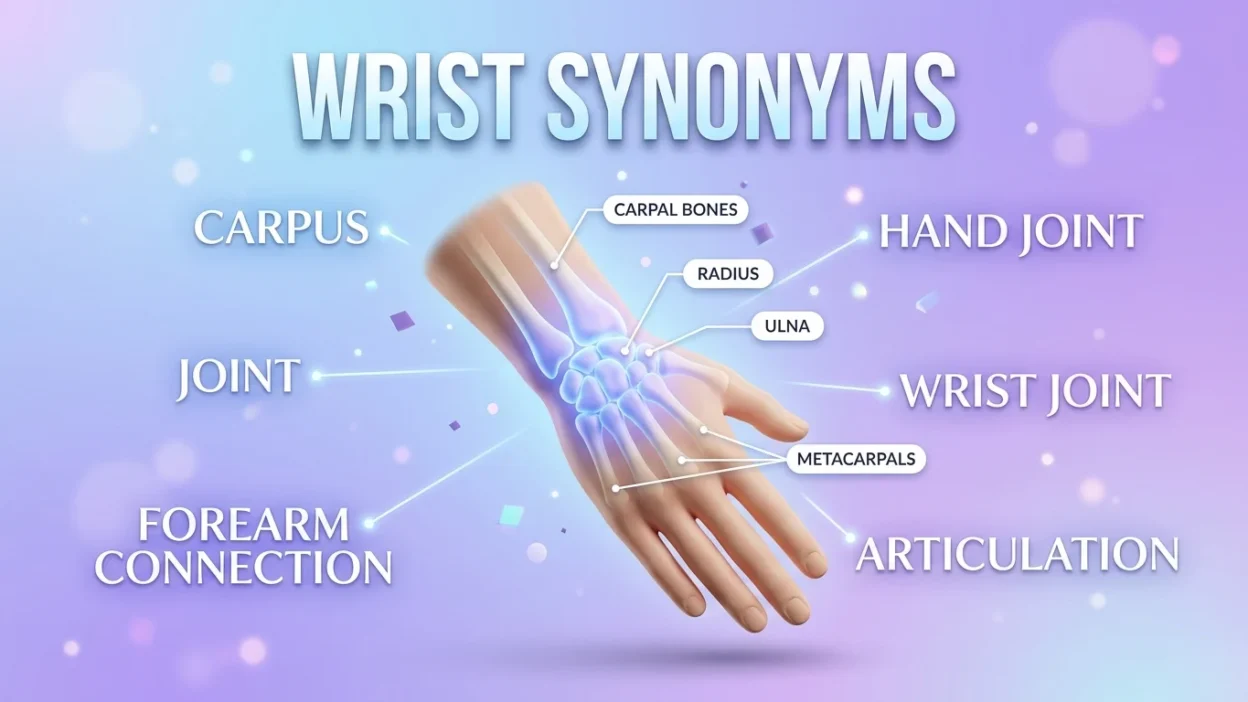
Understanding wrist synonyms can help you describe the human body more precisely and creatively whether you’re writing, studying anatomy, or improving your English vocabulary.
The wrist is a small but important joint that connects the hand to the arm, and while it may seem like a simple word, there are several alternative terms and related expressions you can use depending on context.
For students, ESL learners, and writers, learning synonyms isn’t just about memorizing words it’s about understanding subtle differences in tone, formality, and usage.
Some words may sound more technical, while others feel more casual or descriptive. Knowing when and how to use each one makes your communication clearer and more natural.
In this guide, you’ll explore not only wrist synonyms but also how synonyms work more broadly. To help you practice, we’ll also break down another useful word “demure” with simple explanations, examples, and a rich list of alternatives.
What Does “Demure” Mean?
Demure means quiet, modest, and a little shy in behavior or appearance. It is often used to describe someone (especially a woman) who is calm, reserved, and polite.
- Tone: Positive or neutral
- Usage: Often used in formal or descriptive writing
Example:
She gave a demure smile during the meeting.
30 Synonyms of “Demure” (Simple & Beginner-Friendly)
Below is a carefully explained list to help you understand and use each word correctly.
1. Modest
Meaning: Not showing off; simple and humble
Example: She wore a modest dress.
Usage: Common in daily conversation
2. Reserved
Meaning: Quiet and not expressive
Example: He is reserved in social settings.
Usage: Formal and neutral
3. Shy
Meaning: Nervous around people
Example: The child felt shy at school.
Usage: Very common
4. Quiet
Meaning: Not talking much
Example: She remained quiet during class.
Usage: Everyday use
5. Meek
Meaning: Gentle and easily controlled
Example: He gave a meek reply.
Usage: Slightly negative tone
6. Gentle
Meaning: Soft and kind
Example: She has a gentle voice.
Usage: Positive tone
7. Polite
Meaning: Showing good manners
Example: He gave a polite answer.
Usage: Very common
8. Humble
Meaning: Not proud or arrogant
Example: She stayed humble despite success.
Usage: Positive
9. Ladylike
Meaning: Behaving in a polite, traditional way
Example: Her manners were very ladylike.
Usage: Traditional context
10. Well-mannered
Meaning: Having good behavior
Example: The boy is well-mannered.
Usage: Everyday
11. Soft-spoken
Meaning: Speaking in a quiet voice
Example: He is soft-spoken and calm.
Usage: Positive
12. Timid
Meaning: Lacking confidence
Example: She felt timid in public.
Usage: Slightly negative
13. Introverted
Meaning: Prefers being alone
Example: He is introverted by nature.
Usage: Psychological context
14. Composed
Meaning: Calm and controlled
Example: She stayed composed under pressure.
Usage: Formal
15. Discreet
Meaning: Careful and private
Example: She was discreet about her plans.
Usage: Professional
16. Decent
Meaning: Respectable and proper
Example: He is a decent person.
Usage: General use
17. Refined
Meaning: Elegant and polite
Example: She has refined manners.
Usage: Formal
18. Subdued
Meaning: Quiet and calm
Example: His reaction was subdued.
Usage: Neutral
19. Restrained
Meaning: Controlled emotions
Example: She gave a restrained response.
Usage: Formal
20. Bashful
Meaning: Easily embarrassed
Example: He looked bashful when praised.
Usage: Friendly tone
21. Coy
Meaning: Pretending to be shy
Example: She gave a coy smile.
Usage: Slightly playful
22. Proper
Meaning: Following rules or manners
Example: She behaves in a proper way.
Usage: Formal
23. Prim
Meaning: Very formal and correct
Example: She sounded prim and strict.
Usage: Slightly negative
24. Unassuming
Meaning: Not drawing attention
Example: He is quiet and unassuming.
Usage: Positive
25. Graceful
Meaning: Elegant and calm
Example: She walked gracefully.
Usage: Positive
26. Mild
Meaning: Gentle and not strong
Example: He has a mild personality.
Usage: Neutral
27. Reticent
Meaning: Not speaking much
Example: She is reticent in meetings.
Usage: Formal
28. Self-contained
Meaning: Emotionally controlled
Example: He remained self-contained.
Usage: Formal
29. Chaste
Meaning: Pure and modest
Example: She wore a chaste outfit.
Usage: Formal/literary
30. Dignified
Meaning: Calm and respectable
Example: He gave a dignified speech.
Usage: Formal
Quick Comparison Guide
| Word | Tone | Best Use Case |
| Shy | Casual | Everyday conversation |
| Reserved | Neutral | Social/personality description |
| Modest | Positive | Behavior or clothing |
| Coy | Playful | Flirty or expressive writing |
| Reticent | Formal | Academic/professional writing |
| Prim | Slightly Negative | Criticism or humor |
How to Choose the Right Synonym
Choosing the right synonym depends on tone, context, and intention.
1. For Positive Traits
Use: modest, gentle, graceful, dignified
👉 Best for compliments or respectful descriptions
2. For Neutral Descriptions
Use: quiet, reserved, subdued, mild
👉 Good for general writing
3. For Formal Writing
Use: reticent, composed, restrained, refined
👉 Ideal for essays or professional content
4. For Slightly Negative Meaning
Use: timid, meek, prim
👉 When showing weakness or over-formality
5. For Playful or Creative Tone
Use: coy, bashful
👉 Great for storytelling
Final Thoughts
Learning wrist synonyms helps you expand your vocabulary in a focused topic, but understanding broader synonym usage like with the word demure builds real language confidence. Each synonym carries its own tone, feeling, and context.
Instead of memorizing words blindly, focus on:
- Meaning
- Real-life usage
- Tone and intention
This approach will make your English sound more natural, clear, and engaging whether you’re writing, speaking, or creating content.
Keep practicing, and your vocabulary will grow stronger every day.