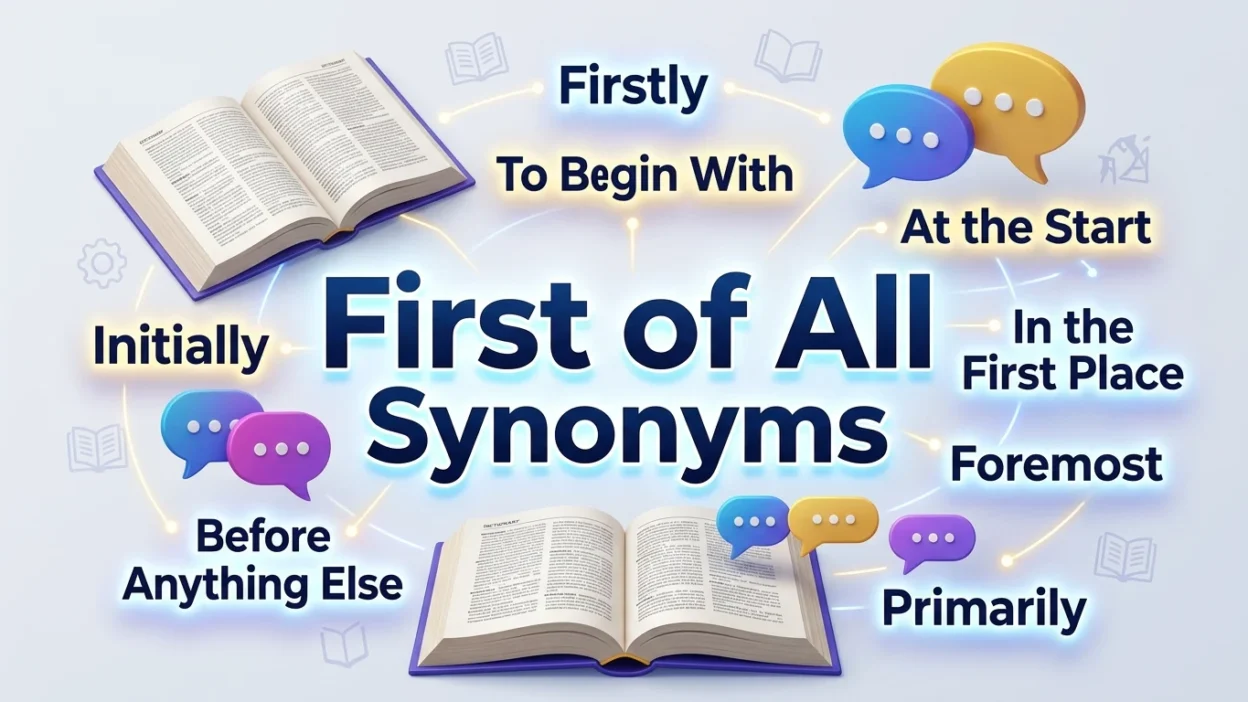
When writing essays, articles, emails, or presentations, many people use the phrase “first of all” to introduce their first point. It is a common expression that helps organize ideas and guide readers through a discussion.
However, repeating the same phrase too often can make your writing sound repetitive. Learning different first of all synonyms can improve your vocabulary, make your communication more natural, and help you choose the right tone for different situations.
If you are a student, ESL learner, writer, or content creator, understanding alternative ways to say “first of all” can make your writing more engaging and professional. In this guide, you’ll discover 30 useful synonyms, their meanings, examples, and the best situations to use them.
What Does “First of All” Mean?
“First of all” is a transitional phrase used to introduce the first point, reason, or idea in a sequence.
Example:
- First of all, we need to understand the problem before finding a solution.
The phrase signals that more points may follow.
30 Synonyms for “First of All”
1. Firstly
Meaning: Used to introduce the first point in a list.
Example: Firstly, let’s discuss the project’s goals.
Best Usage Context: Formal writing and presentations.
2. First
Meaning: The simplest way to introduce the opening point.
Example: First, gather all the necessary information.
Best Usage Context: Everyday writing and speech.
3. To Begin With
Meaning: Used to start a discussion or explanation.
Example: To begin with, we should review the budget.
Best Usage Context: Formal and informal communication.
4. Initially
Meaning: Refers to the beginning stage of something.
Example: Initially, the plan seemed difficult.
Best Usage Context: Professional and academic writing.
5. At First
Meaning: During the early stage of an event or situation.
Example: At first, I didn’t understand the instructions.
Best Usage Context: Storytelling and personal experiences.
6. In the First Place
Meaning: Refers to the original reason or starting point.
Example: Why did we choose this method in the first place?
Best Usage Context: Explanations and arguments.
7. Before Anything Else
Meaning: Indicates the most important first action.
Example: Before anything else, ensure your safety.
Best Usage Context: Instructions and advice.
8. As a Starting Point
Meaning: Introduces the initial step or idea.
Example: As a starting point, let’s examine the data.
Best Usage Context: Business and academic discussions.
9. To Start With
Meaning: A natural way to begin a point.
Example: To start with, we need more research.
Best Usage Context: Casual and professional writing.
10. Primarily
Meaning: Mainly or first in importance.
Example: Primarily, our focus is customer satisfaction.
Best Usage Context: Business communication.
11. Foremost
Meaning: Most important and first in priority.
Example: Foremost, we must protect user privacy.
Best Usage Context: Formal writing.
12. Chiefly
Meaning: Mainly or principally.
Example: Chiefly, the success came from teamwork.
Best Usage Context: Formal reports.
13. Most Importantly
Meaning: Highlights the key first point.
Example: Most importantly, stay consistent.
Best Usage Context: Advice and recommendations.
14. Above All
Meaning: More important than anything else.
Example: Above all, be honest.
Best Usage Context: Inspirational writing.
15. In the Beginning
Meaning: At the start of a process or event.
Example: In the beginning, progress was slow.
Best Usage Context: Narratives and explanations.
16. At the Outset
Meaning: At the very start.
Example: At the outset, expectations were clear.
Best Usage Context: Formal and professional writing.
17. At the Start
Meaning: At the beginning.
Example: At the start, everyone was excited.
Best Usage Context: General writing.
18. First and Foremost
Meaning: Most importantly and before anything else.
Example: First and foremost, thank you for your support.
Best Usage Context: Speeches and formal communication.
19. Prior to Everything Else
Meaning: Before all other considerations.
Example: Prior to everything else, verify the facts.
Best Usage Context: Formal instructions.
20. In the Initial Stage
Meaning: During the beginning phase.
Example: In the initial stage, training is essential.
Best Usage Context: Academic and business writing.
21. To Kick Things Off
Meaning: To start something.
Example: To kick things off, let’s introduce ourselves.
Best Usage Context: Casual conversation.
22. At the Very Beginning
Meaning: Right at the start.
Example: At the very beginning, goals were clearly defined.
Best Usage Context: Storytelling and reports.
23. One
Meaning: Introduces the first item in a numbered list.
Example: One, we need better planning.
Best Usage Context: Speeches and presentations.
24. For Starters
Meaning: An informal way to introduce the first point.
Example: For starters, improve your time management.
Best Usage Context: Casual writing.
25. The First Step Is
Meaning: Introduces an initial action.
Example: The first step is creating a strategy.
Best Usage Context: Guides and tutorials.
26. Before Proceeding
Meaning: Prior to moving forward.
Example: Before proceeding, read the instructions carefully.
Best Usage Context: Instructions.
27. To Open With
Meaning: Used to begin a statement.
Example: To open with, I’d like to share an example.
Best Usage Context: Presentations.
28. At the Commencement
Meaning: At the beginning.
Example: At the commencement of the project, objectives were set.
Best Usage Context: Very formal writing.
29. In the Early Stages
Meaning: During the beginning phase.
Example: In the early stages, growth was steady.
Best Usage Context: Business and academic discussions.
30. As an Introduction
Meaning: Used to present an opening point.
Example: As an introduction, let’s review the basics.
Best Usage Context: Educational content.
Quick Comparison Guide
| Synonym | Formality | Best For |
| Firstly | High | Essays, reports |
| First | Neutral | Everyday writing |
| To Begin With | Medium | General communication |
| Initially | High | Professional writing |
| At First | Neutral | Storytelling |
| Above All | Medium | Advice and inspiration |
| First and Foremost | High | Speeches |
| For Starters | Low | Casual conversation |
| To Kick Things Off | Low | Friendly discussions |
| At the Outset | High | Business reports |
How to Choose the Right Synonym
For Academic Writing
Use:
- Firstly
- Initially
- At the Outset
- In the Initial Stage
For Business Communication
Use:
- Primarily
- Foremost
- Chiefly
- Most Importantly
For Casual Conversation
Use:
- First
- To Start With
- For Starters
- To Kick Things Off
For Speeches and Presentations
Use:
- First and Foremost
- To Open With
- Most Importantly
- As a Starting Point
For Storytelling
Use:
- At First
- In the Beginning
- At the Very Beginning
- In the Early Stages
Common Mistakes to Avoid
- Repeating “first of all” too often in one piece of writing.
- Using overly formal synonyms in casual conversations.
- Mixing formal and informal transitions in the same document.
- Choosing a synonym that doesn’t match the tone of your audience.
Conclusion
Learning different first of all synonyms can significantly improve your writing and speaking skills. While “first of all” is useful, alternatives such as firstly, to begin with, initially, above all, and first and foremost can make your communication more varied and effective.
The best synonym depends on your audience, purpose, and tone. Students can benefit from formal options like firstly, professionals may prefer primarily or at the outset, while everyday conversations often sound more natural with first or to start with.
By practicing these alternatives, you’ll build a stronger vocabulary, create smoother transitions, and communicate your ideas more clearly and confidently.