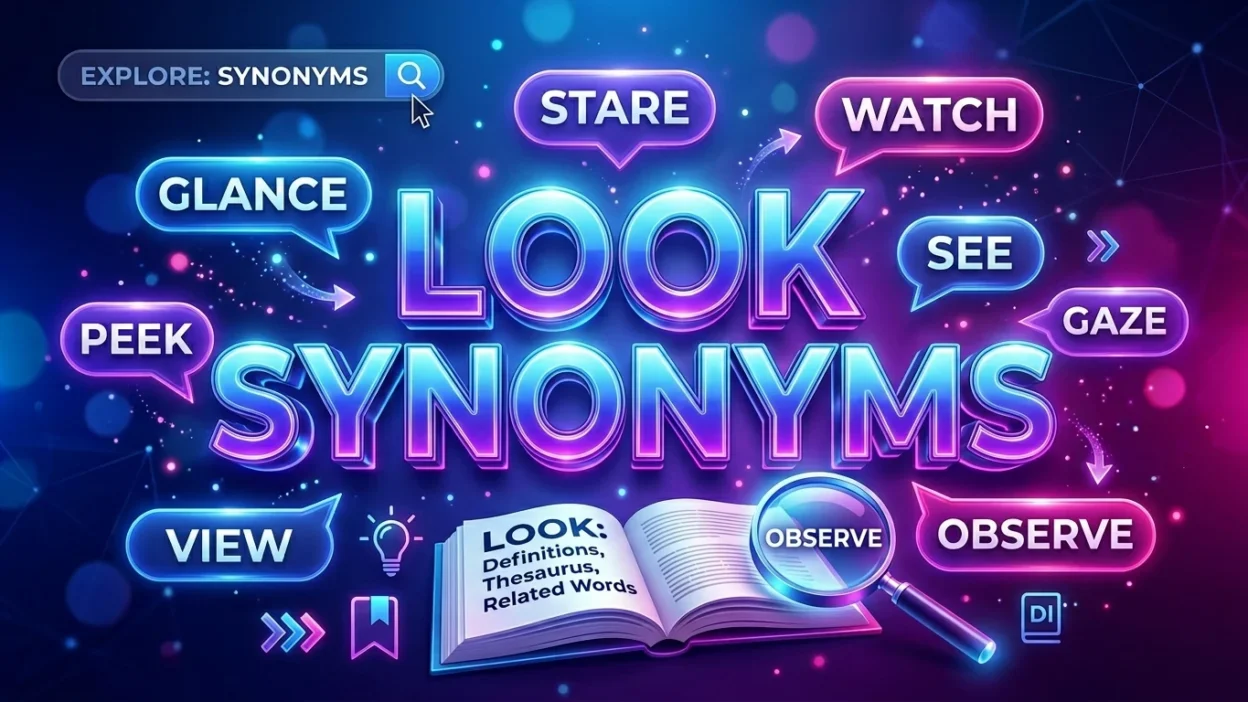
Words shape the way we communicate. One simple word can have many meanings depending on tone, situation, and context. The word “look” is one of the most commonly used English words, but repeating it too often can make writing sound dull or repetitive. That is why learning synonyms is important for students, writers, ESL learners, and content creators.
Different synonyms of “look” can express emotions, attention, appearance, or observation in more specific ways. For example, “glance” suggests a quick look, while “stare” shows a long and intense look. Choosing the right synonym helps your writing sound more natural, expressive, and professional.
In this guide, you will learn the meaning of “look,” discover 30 useful look synonyms, understand their usage, and learn how to choose the best word for different situations. Every explanation is written in simple English to make learning easy and enjoyable.
What Does “Look” Mean?
The word “look” usually means to direct your eyes toward something or someone. It can also describe appearance, expression, or attention.
Simple Examples:
- Look at the sky.
- She looked happy today.
- He looked carefully at the painting.
Because “look” has many meanings, English uses many synonyms depending on the situation and tone.
30 Best Look Synonyms
1. Glance
Meaning: A quick and short look.
Example Sentence: She glanced at her phone during class.
Best Usage Context: Casual or quick observation.
2. Stare
Meaning: To look at something for a long time.
Example Sentence: The child stared at the magician in amazement.
Best Usage Context: Strong attention or surprise.
3. Gaze
Meaning: To look steadily and calmly.
Example Sentence: They gazed at the sunset together.
Best Usage Context: Romantic or thoughtful situations.
4. Peek
Meaning: To look quickly or secretly.
Example Sentence: He peeked through the door quietly.
Best Usage Context: Secret or playful situations.
5. Glimpse
Meaning: A very brief look.
Example Sentence: I caught a glimpse of the celebrity.
Best Usage Context: Short accidental viewing.
6. Watch
Meaning: To look carefully over time.
Example Sentence: We watched the football match all evening.
Best Usage Context: Events or activities.
7. Observe
Meaning: To notice something carefully.
Example Sentence: Scientists observe animal behavior daily.
Best Usage Context: Formal or academic writing.
8. Notice
Meaning: To become aware of something.
Example Sentence: Did you notice the new painting?
Best Usage Context: Everyday conversations.
9. Examine
Meaning: To inspect carefully in detail.
Example Sentence: The doctor examined the patient closely.
Best Usage Context: Medical or professional situations.
10. Inspect
Meaning: To check carefully for problems.
Example Sentence: Workers inspected the building for damage.
Best Usage Context: Technical or official tasks.
11. View
Meaning: To look at something intentionally.
Example Sentence: Thousands viewed the video online.
Best Usage Context: Media or digital content.
12. Study
Meaning: To look carefully to learn details.
Example Sentence: She studied the map before traveling.
Best Usage Context: Learning and research.
13. Scan
Meaning: To look over something quickly.
Example Sentence: He scanned the newspaper headlines.
Best Usage Context: Reading or searching.
14. Read
Meaning: To look at written words for understanding.
Example Sentence: I read the article yesterday.
Best Usage Context: Books, articles, and documents.
15. Spy
Meaning: To secretly notice something.
Example Sentence: She spied a cat behind the tree.
Best Usage Context: Secret observation.
16. Eye
Meaning: To look at with interest.
Example Sentence: He eyed the chocolate cake hungrily.
Best Usage Context: Desire or curiosity.
17. Behold
Meaning: To see something impressive.
Example Sentence: They beheld the beautiful palace.
Best Usage Context: Literary or dramatic writing.
18. Witness
Meaning: To see an event happen.
Example Sentence: Many people witnessed the accident.
Best Usage Context: Legal or serious events.
19. Monitor
Meaning: To watch continuously.
Example Sentence: Nurses monitored the patient overnight.
Best Usage Context: Health or security contexts.
20. Spot
Meaning: To suddenly notice something.
Example Sentence: I spotted my friend in the crowd.
Best Usage Context: Finding someone or something.
21. Peer
Meaning: To look closely with difficulty.
Example Sentence: The old man peered through his glasses.
Best Usage Context: Weak visibility.
22. Squint
Meaning: To look with partly closed eyes.
Example Sentence: She squinted in the bright sunlight.
Best Usage Context: Bright light or unclear vision.
23. Leer
Meaning: To look in an unpleasant way.
Example Sentence: The stranger leered at the woman.
Best Usage Context: Negative or rude behavior.
24. Admire
Meaning: To look at with pleasure or respect.
Example Sentence: Tourists admired the ancient monument.
Best Usage Context: Beauty or respect.
25. Contemplate
Meaning: To look thoughtfully for a long time.
Example Sentence: He contemplated the painting quietly.
Best Usage Context: Deep thinking.
26. Search
Meaning: To look carefully to find something.
Example Sentence: Police searched the area thoroughly.
Best Usage Context: Finding lost items.
27. Check
Meaning: To look quickly for confirmation.
Example Sentence: Please check your email inbox.
Best Usage Context: Daily tasks.
28. Review
Meaning: To examine again carefully.
Example Sentence: The manager reviewed the report.
Best Usage Context: Work or study.
29. Survey
Meaning: To look over a wide area.
Example Sentence: The pilot surveyed the land below.
Best Usage Context: Large scenes or research.
30. Peek At
Meaning: To secretly or briefly look at something.
Example Sentence: Don’t peek at the answers.
Best Usage Context: Informal situations.
Quick Comparison Table for Look Synonyms
| Synonym | Main Meaning | Tone | Best Situation |
| Glance | Quick look | Casual | Everyday use |
| Stare | Long intense look | Strong | Surprise or shock |
| Gaze | Calm steady look | Soft | Romantic moments |
| Observe | Careful watching | Formal | Academic writing |
| Peek | Secret quick look | Playful | Informal situations |
| Examine | Detailed inspection | Professional | Medical or technical use |
| Spot | Suddenly notice | Casual | Crowds or searching |
| Monitor | Continuous watching | Formal | Health and security |
| Admire | Look with appreciation | Positive | Beauty and art |
| Contemplate | Thoughtful looking | Deep | Reflection and thinking |
How to Choose the Right Synonym
Choosing the correct synonym depends on tone, purpose, and context. Here are some simple ways to decide.
For Quick Looks
Use:
- Glance
- Peek
- Glimpse
- Scan
These words work best when the look lasts only a short time.
For Deep or Long Attention
Use:
- Stare
- Gaze
- Contemplate
- Observe
These words suggest longer focus or emotional attention.
For Professional or Formal Writing
Use:
- Examine
- Inspect
- Monitor
- Review
These are common in workplaces, schools, and official communication.
For Emotional or Artistic Situations
Use:
- Admire
- Behold
- Gaze
These words add beauty and emotion to writing.
For Searching or Finding
Use:
- Search
- Spot
- Survey
These words fit situations where someone is trying to find something.
Common Mistakes When Using Look Synonyms
Using “Stare” in Friendly Situations
“Stare” can sound rude or aggressive. Use “gaze” for softer situations.
Confusing “Glance” and “Glimpse”
A “glance” is intentional, while a “glimpse” is usually accidental.
Overusing Formal Words
Words like “behold” or “inspect” may sound unnatural in casual conversation.
Why Learning Look Synonyms Matters
Learning synonyms improves both speaking and writing skills. It helps:
- Avoid repetition
- Make writing more interesting
- Express emotions clearly
- Improve academic and creative writing
- Build stronger English vocabulary
Students and ESL learners especially benefit from understanding how different words create different tones.
Conclusion
Understanding look synonyms can greatly improve your English vocabulary and communication skills. While the word “look” is simple and useful, its synonyms help express different emotions, levels of attention, and situations more clearly.
Words like “glance,” “gaze,” “observe,” and “stare” each carry unique meanings and tones. By learning when and how to use them, you can write more naturally, speak more confidently, and avoid repetitive language.
Practice these synonyms in daily conversations, essays, and creative writing to make your English sound richer and more professional over time.