Words help us express ideas clearly and accurately. Sometimes, however, using the same word repeatedly can make writing feel dull or repetitive. That’s where learning synonyms becomes useful.
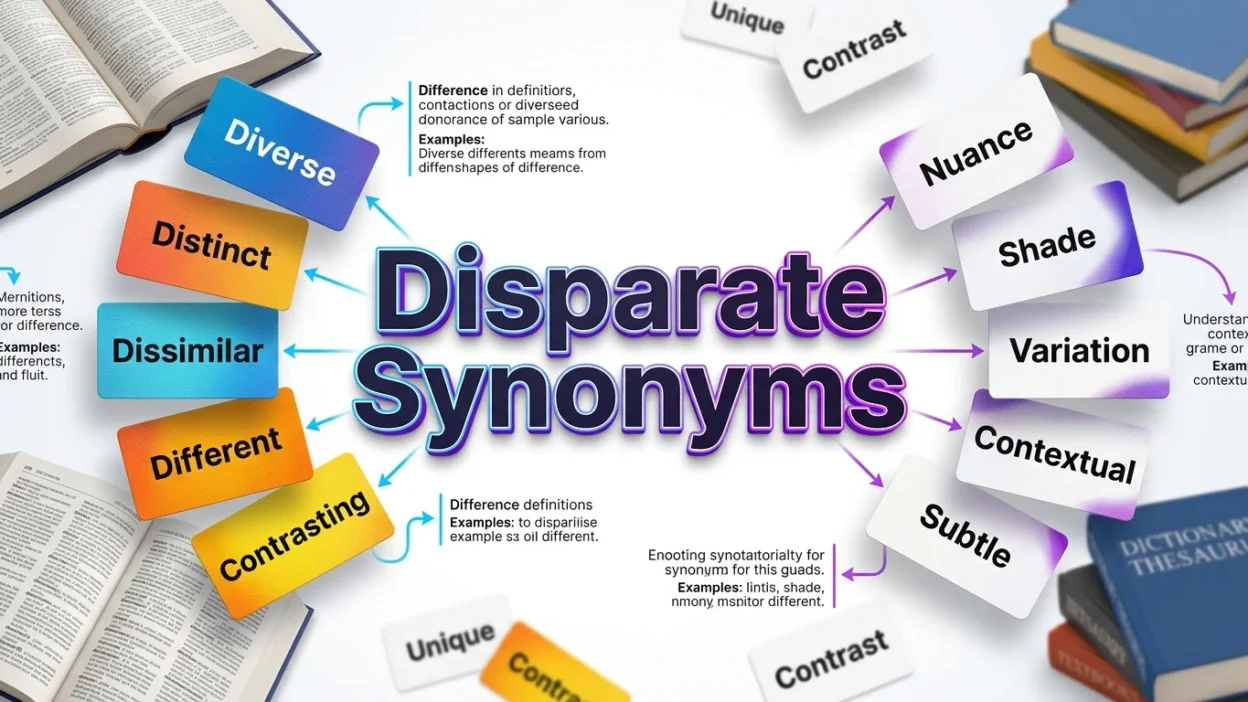
If you’re searching for disparate synonyms, you’re likely looking for alternative words that convey the idea of things being different, unrelated, or distinct from one another.
The word disparate is commonly used in academic writing, business communication, journalism, and everyday conversations. Understanding its synonyms can help students, ESL learners, writers, and content creators improve their vocabulary and communicate more effectively.
In this guide, you’ll learn the meaning of disparate, discover 30 useful disparate synonyms, see practical examples, and understand when to use each alternative in different situations.
What Does Disparate Mean?
Disparate means fundamentally different, distinct, or unrelated in nature. It describes things that do not seem to belong together because they differ greatly from each other.
Example:
- The committee consisted of people from disparate backgrounds.
- The report combined data from several disparate sources.
30 Disparate Synonyms
1. Different
Meaning: Not the same.
Example: The two cultures have different traditions.
Best Usage: General everyday communication.
2. Distinct
Meaning: Clearly separate and unique.
Example: Each department has a distinct role.
Best Usage: Formal and professional writing.
3. Diverse
Meaning: Showing variety.
Example: The city has a diverse population.
Best Usage: People, cultures, ideas, and groups.
4. Dissimilar
Meaning: Not alike.
Example: Their opinions were dissimilar.
Best Usage: Comparisons.
5. Unrelated
Meaning: Having no connection.
Example: The two events were unrelated.
Best Usage: Facts and circumstances.
6. Contrasting
Meaning: Showing noticeable differences.
Example: The article presents contrasting viewpoints.
Best Usage: Comparisons and analysis.
7. Divergent
Meaning: Moving in different directions.
Example: The team had divergent goals.
Best Usage: Academic and business contexts.
8. Varied
Meaning: Having many different forms.
Example: She has varied interests.
Best Usage: General descriptions.
9. Separate
Meaning: Existing independently.
Example: The issues should be handled separately.
Best Usage: Organizational contexts.
10. Independent
Meaning: Not influenced by another thing.
Example: The studies were conducted independently.
Best Usage: Research and business.
11. Incompatible
Meaning: Unable to work together.
Example: Their approaches were incompatible.
Best Usage: Relationships and systems.
12. Opposite
Meaning: Completely different.
Example: They held opposite opinions.
Best Usage: Strong contrasts.
13. Contrary
Meaning: Opposing in nature.
Example: His actions were contrary to expectations.
Best Usage: Formal writing.
14. Diverging
Meaning: Gradually becoming different.
Example: Their interests are diverging.
Best Usage: Trends and development.
15. Multifaceted
Meaning: Having many different aspects.
Example: The issue is multifaceted.
Best Usage: Complex topics.
16. Heterogeneous
Meaning: Made up of different elements.
Example: The class was heterogeneous.
Best Usage: Academic and scientific writing.
17. Miscellaneous
Meaning: Consisting of various kinds.
Example: The drawer contained miscellaneous items.
Best Usage: Collections of objects.
18. Mixed
Meaning: Containing different elements.
Example: The feedback was mixed.
Best Usage: Everyday language.
19. Contradictory
Meaning: Opposing each other.
Example: The witnesses gave contradictory statements.
Best Usage: Reports and discussions.
20. Disconnected
Meaning: Not linked together.
Example: The ideas seemed disconnected.
Best Usage: Communication and logic.
21. Unmatched
Meaning: Not corresponding with something else.
Example: Their skills were unmatched.
Best Usage: Comparisons.
22. Unequal
Meaning: Not the same in amount or value.
Example: The resources were distributed unequally.
Best Usage: Statistics and social topics.
23. Assorted
Meaning: Various types grouped together.
Example: The basket contained assorted fruits.
Best Usage: Product descriptions.
24. Differing
Meaning: Not agreeing or matching.
Example: The experts had differing opinions.
Best Usage: Discussions and debates.
25. Polarized
Meaning: Divided into opposing groups.
Example: The issue polarized voters.
Best Usage: Politics and social issues.
26. Distinguishable
Meaning: Able to be recognized as different.
Example: The brands are easily distinguishable.
Best Usage: Comparisons.
27. Nonuniform
Meaning: Not consistent throughout.
Example: The results were nonuniform.
Best Usage: Technical writing.
28. Irreconcilable
Meaning: Impossible to bring together.
Example: They had irreconcilable differences.
Best Usage: Conflicts and disagreements.
29. Diverse in Nature
Meaning: Different in characteristics.
Example: The projects were diverse in nature.
Best Usage: Formal descriptions.
30. Distanced
Meaning: Separated or detached.
Example: The groups remained distanced from one another.
Best Usage: Social and organizational contexts.
Comparison Table: When to Use Different Disparate Synonyms
| Synonym | Best For | Tone |
| Different | Everyday speech | Casual |
| Distinct | Professional writing | Formal |
| Diverse | Variety and inclusion | Neutral |
| Divergent | Academic discussions | Formal |
| Unrelated | No connection | Neutral |
| Contrasting | Comparisons | Neutral |
| Heterogeneous | Scientific writing | Technical |
| Incompatible | Conflicts | Formal |
| Opposite | Strong differences | Casual |
| Irreconcilable | Serious disagreements | Formal |
How to Choose the Right Synonym
Choosing the best disparate synonym depends on the context and tone you want to create.
For Everyday Communication
Use:
- Different
- Mixed
- Varied
- Separate
These words are easy to understand and suitable for general conversations.
For Academic Writing
Use:
- Divergent
- Heterogeneous
- Distinct
- Dissimilar
These options sound more professional and precise.
For Business and Professional Contexts
Use:
- Distinct
- Independent
- Contrasting
- Incompatible
These words work well in reports and presentations.
For Strong Differences or Conflicts
Use:
- Opposite
- Contrary
- Contradictory
- Irreconcilable
These synonyms emphasize disagreement or opposition.
For Variety and Diversity
Use:
- Diverse
- Assorted
- Multifaceted
- Varied
These words highlight a broad range of elements rather than conflict.
Common Examples of Disparate in Sentences
- The company merged several disparate teams into one department.
- Researchers gathered information from disparate sources.
- The project combines disparate technologies to solve a problem.
- People from disparate cultures attended the conference.
- The report examines disparate viewpoints on climate change.
FAQs
What is the closest synonym to disparate?
The closest synonyms are different, distinct, dissimilar, and unrelated.
Is diverse a synonym for disparate?
Yes, in some contexts. However, diverse usually emphasizes variety, while disparate often emphasizes significant differences.
Can disparate have a negative meaning?
Not always. It simply describes things that are very different. Whether it’s positive or negative depends on the context.
Which disparate synonym is best for academic writing?
Divergent, heterogeneous, distinct, and dissimilar are excellent choices for academic writing.
Conclusion
Understanding disparate synonyms can greatly improve your vocabulary and writing skills. While disparate refers to things that are fundamentally different or unrelated, many alternative words can express similar ideas with slightly different tones and meanings.
Words such as distinct, diverse, divergent, dissimilar, and unrelated are especially useful in academic, professional, and everyday communication.
By learning when and how to use these synonyms, you can make your writing more precise, engaging, and natural. If you’re a student, ESL learner, writer, or content creator, expanding your vocabulary with these alternatives will help you communicate with greater confidence and clarity.